Discover How Adaptive Attackers Bypass Your EDR.
Then Prove the Fix Holds.
RefineSec tests real post-compromise behavior through adaptive, polymorphic execution. When a technique gets through, RefineSec generates environment-specific behavioral detection logic and retests new variants to prove the protection holds.
Known attacks test coverage. Adaptive attacks test resilience.
Vendor Agnostic
Isolated, tightly controlled execution designed to avoid production impact. Actionable results on the same day.
Coverage Testing vs Resilience Testing
Traditional validation measures whether known attack content is blocked or detected. RefineSec is vendor agnostic: it examines how any endpoint control responds when the implementation changes and turns demonstrated gaps into detection improvements.
The comparison below is scoped to endpoint-defense validation. Capabilities are labelled by what is available today.
| Manual Pen Testing | Traditional BAS | RefineSec | |
|---|---|---|---|
| Full behavioral execution of post-compromise TTPs | Varies | ||
| Execution adapts after prevention occurs | Scoped | Not primary | |
| Multiple implementations per technique (polymorphic variants) | Scoped | Partial | |
| Prevention, telemetry and alerting recorded separately | Scoped | ||
| Endpoint-defense depth as the primary focus | Scoped | Broad, less deep | |
| Environment-specific behavioral detection logic generated | Not primary | Partial | |
| Rules written in your EDR's native rule language | Not primary | Partial | |
| Reproducible execution evidence per technique | Scoped | ||
| Multi-vendor endpoint comparison from one campaign | Not primary | Partial | |
| Deploy and begin first campaign in under an hour | Not primary | Varies | |
| Generalization testing against unseen variants | Scoped | Not primary | |
| Continuous regression testing after control changes | Not primary | Partial | |
| Rule deployment into the control | Not primary | Partial |
- Available today
- Partial Supported in part, or varies by vendor
- Scoped Depends on the engagement and tester
- Not primary Not a primary capability of that approach
The Adaptive EDR Resilience Loop
RefineSec does not treat one successful simulation as proof of resilience. It changes the implementation, observes how the control responds, identifies working evasions and turns demonstrated gaps into measurable defensive improvements.
Where This Sits in CTEM
Continuous Threat Exposure Management asks which exposures matter. Adversarial Exposure Validation answers whether they are actually exploitable. RefineSec operates as that validation layer for endpoint defenses, then produces the fix.
- Establish which attacker implementations get through your controls today
- Separate what was prevented from what was only logged
- Convert a demonstrated gap into behavioral detection logic for your environment
Click a stage above to read more.
A rule that detects the original sample may still miss the underlying technique. RefineSec evaluates whether protection survives changes in tooling, command line, parent process, execution flow and artifacts.
Deploy. Adapt. Close the Gap.
Isolated, tightly controlled execution designed to avoid production impact. Actionable results on the same day.
Deploy in Minutes
Isolated execution, defined boundaries.
A lightweight agent runs on one VM alongside your endpoint controls. No network or integration changes. First campaign starts in under an hour. Endpoint first.
Test Materially Different Implementations
Adaptive, not a static replay.
Select relevant threat actors or specific techniques. Each technique is executed through multiple implementations so you learn how the control responds when the method changes, not just whether one known variant is blocked.
Turn the Gap Into Detection Logic
Native to your EDR, not a generic template.
Every demonstrated gap comes with behavioral detection logic built from the variant that got through, written in the rule language of each EDR you run. Reviewable by your detection engineers before it ships.
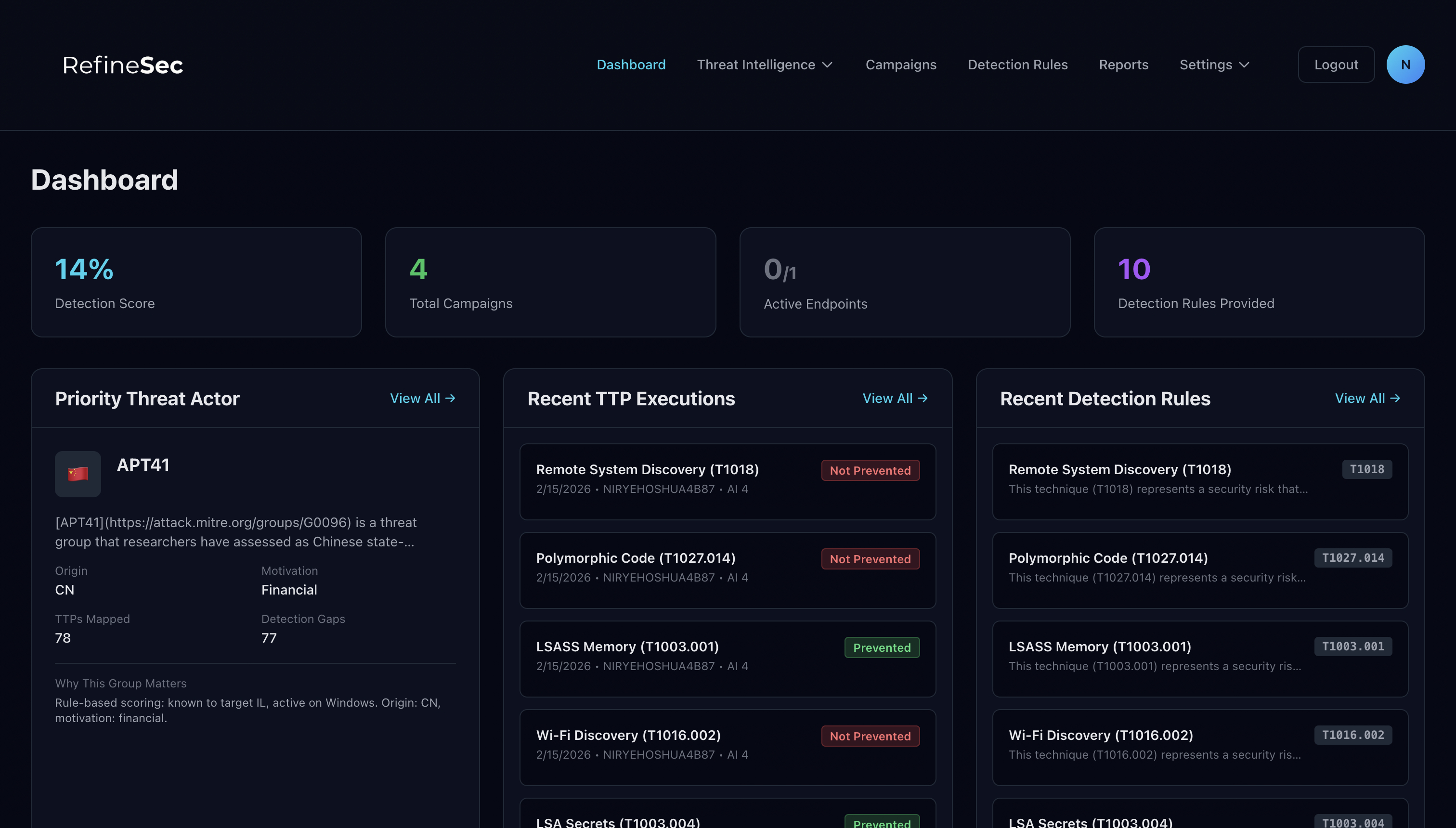
One Dashboard. Complete Clarity.
Every technique, every variant, every control response in one place. Compare endpoint products side by side against the same behavior.
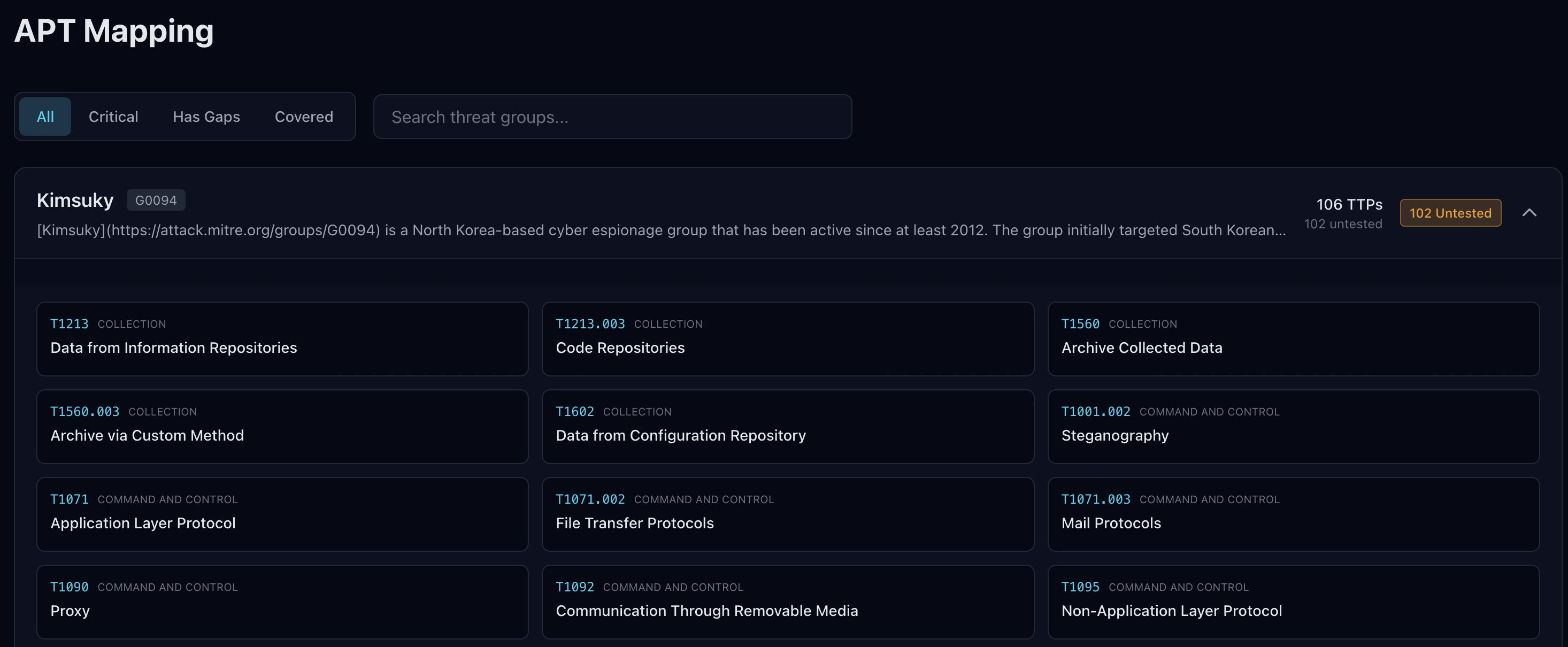
Threat Intelligence That Becomes Executable Validation
RefineSec transforms relevant threat intelligence into executable, customer-specific validation. Emerging adversary behavior is mapped to the organization's endpoint stack, telemetry and previous validation results before campaigns are generated.
- Operating systems in scope
- Deployed endpoint controls and their configuration
- Telemetry actually available for detection
- Threat actors relevant to your industry
- Results and known control failures from previous campaigns
- Assets and systems inside the authorized testing scope
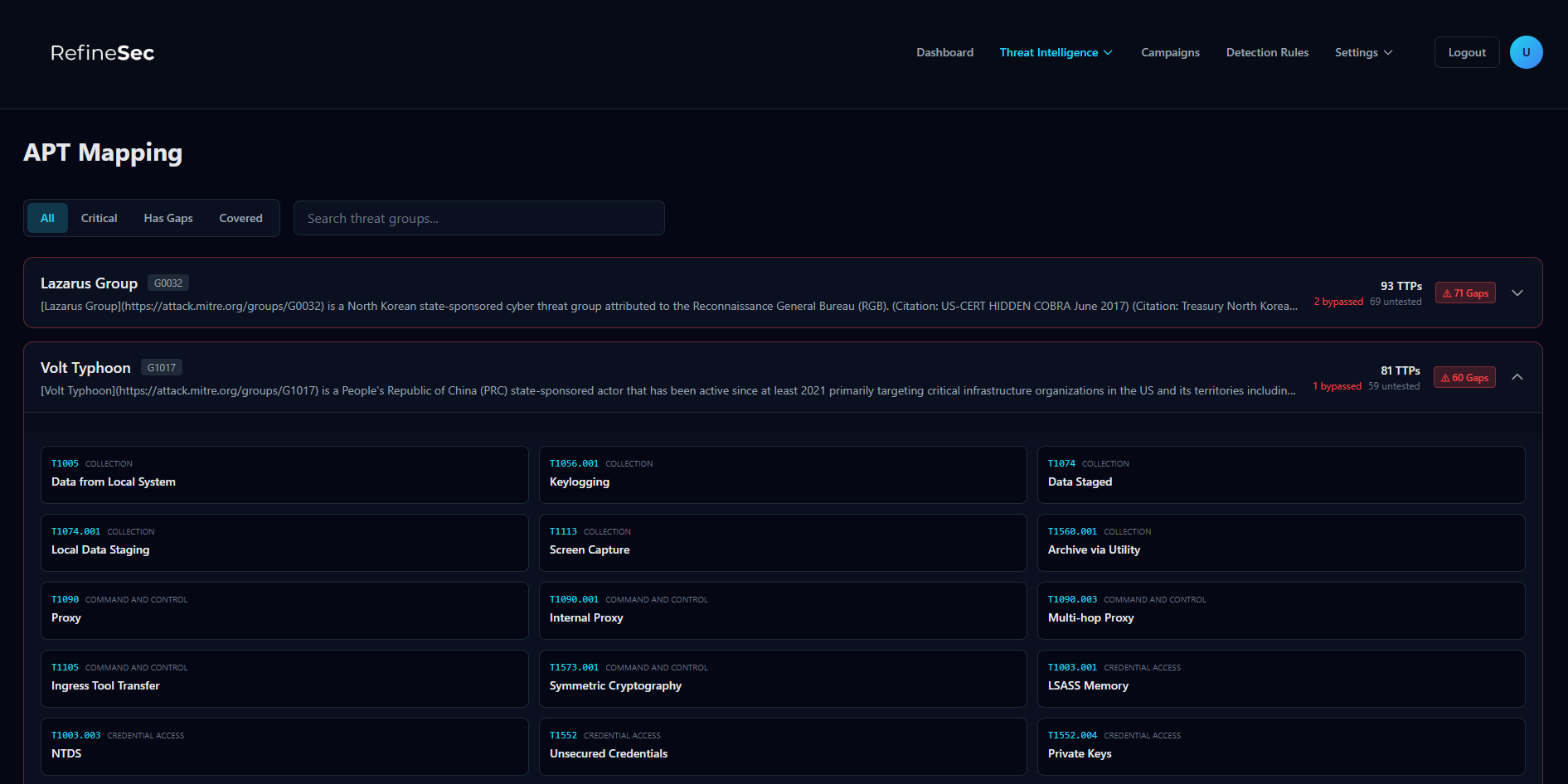
Evidence, Not Assertions
Results are reported per technique, per variant and per control, so a coverage figure can always be traced back to the execution that produced it.
Coverage You Can Trace to an Execution
Coverage is broken down by threat actor, ATT&CK technique and endpoint product. Each result links to the implementation that was executed and what the control recorded, so a low score is a work item rather than a headline.
Board-Ready Outcomes
Detection Logic Grounded in a Demonstrated Risk
RefineSec does not generate rules from theory alone. Detection logic is grounded in behavior that successfully passed through the customer's actual control, relevant telemetry and the specific implementation that exposed the gap.
One demonstrated gap produces a rule for every EDR in your stack, written in each vendor's own rule language.
Written for Your Telemetry, Not a Generic Template
Generated rules are intended to be reviewed and owned by your detection engineers, not dropped into production unseen.
- Written in your EDR's own rule format, ready for its detection policy
- Behavioral, rather than dependent only on hashes or filenames
- Aligned to the relevant MITRE ATT&CK technique
- Tailored to the telemetry your stack actually records
- Reviewable and editable before anything is applied
- Tested against the behavior that produced the gap
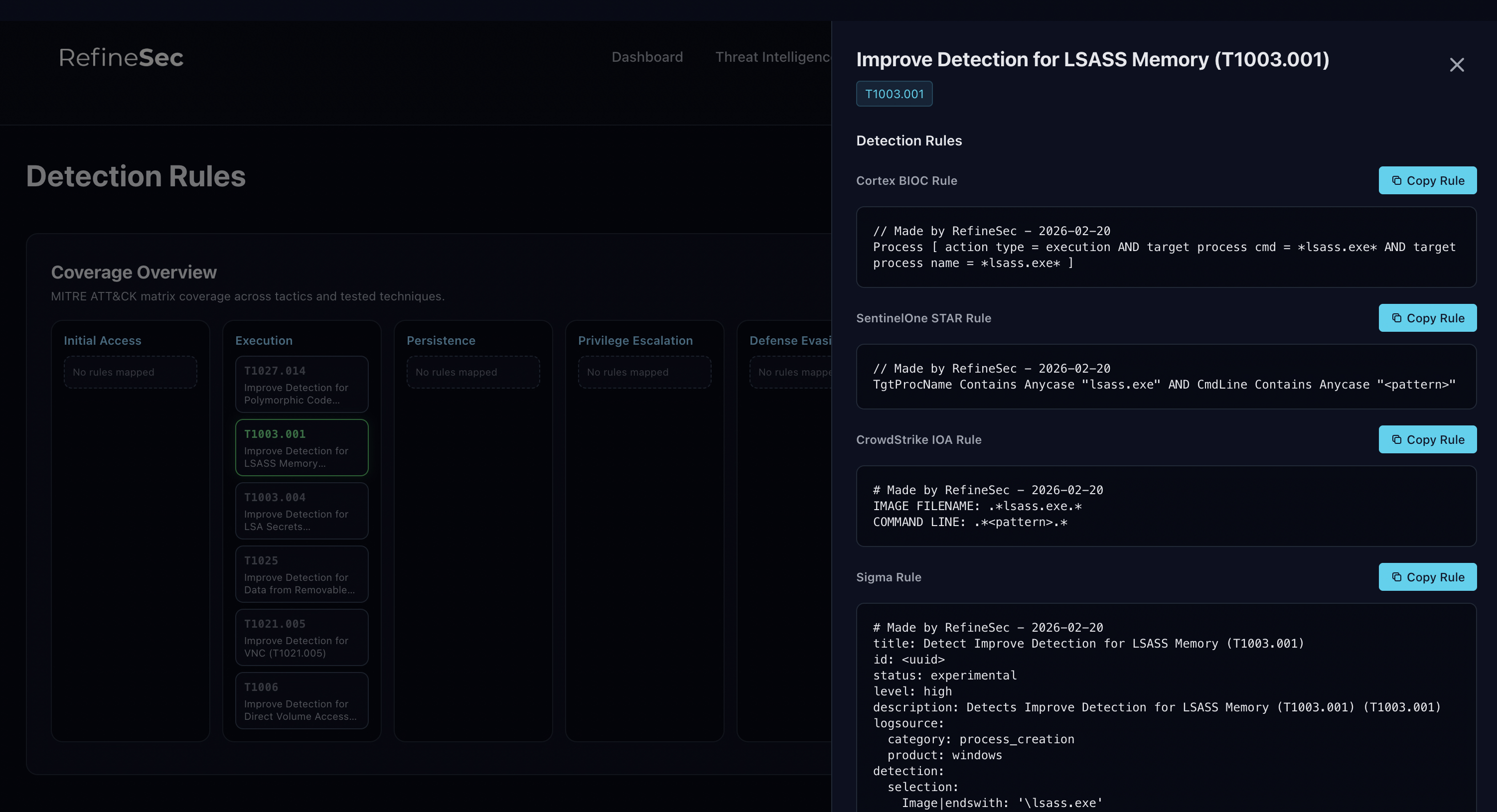
One Gap. A Rule for Every EDR in Your Stack.
Vendor agnostic: any EDR can be tested. For the platforms below, RefineSec goes further and writes the rule in the vendor's own format, ready to add to that product's detection policy, so your engineers are not translating a generic rule into their own platform.














Running a different endpoint product? It can still be tested, and more native rule formats are added on request.
Detect the Behavior, Not Just the Sample
Changing a filename, binary, command line or parent process should not be enough to defeat the new detection. RefineSec evaluates whether the rule captures the underlying attacker behavior across materially different implementations, so a fix is validated against adaptation rather than against the one sample that exposed the gap.
Autonomous and Adaptive Agentic AI. Governed for Enterprise Security.
Adaptive execution only belongs in an enterprise environment when its boundaries are explicit. RefineSec is designed for controlled, authorized security validation.
Campaigns run against systems you own or are explicitly authorized to test, under the scope you define.
Execution is contained to a dedicated VM running alongside your endpoint controls, designed to avoid production impact.
Targets, techniques and execution limits are set before a campaign starts, so adaptation happens inside a known perimeter.
Generated detection logic is presented for engineer review and stays under your ownership. Nothing is applied to a control without you.
Each result records the implementation executed and what the control observed, so findings can be independently re-checked.
Offensive implementation detail stays inside the platform and the engagement. It is not published or shared beyond authorized users.
Techniques run far enough to prove the behavior, not to cause damage. No destructive payloads, no encryption of your data.
A running campaign can be halted at any point, so you keep control of execution rather than waiting for it to finish.
Built for Every Role on Your Security Team
The same validation evidence, read differently by each audience.
Answer "Are we protected?" with evidence showing what was prevented, what was detected, which variants bypassed controls and what defensive improvements were produced.
Identify where attack telemetry fails to become an actionable alert and prioritize the detection gaps that create real operational risk.
See the exact behavior and variants that bypassed the control, then review detection logic grounded in the observed telemetry.
Extend testing beyond the canonical implementation. Evaluate how defenses respond as execution paths, tooling and artifacts change.
Validate prevention, detection and self-protection against real-world TTPs and evasive variants. Turn demonstrated weaknesses into practical product and detection-engineering improvements.
Compare how different endpoint products handle the same behavior, and make stack and renewal decisions from execution evidence rather than vendor claims.
Start hunts from behavior that produced telemetry but never raised an alert, using the exact variants that passed through the control.
Show assessors that controls were tested against real adversary behavior, with reproducible results and the detection improvements that followed.
Vendor Agnostic
Works with the platforms you trust. Every listed endpoint product is put under test and hardened with native detection rules written in that vendor's own format.
Endpoint Testing and Native Detection Rules
Techniques execute on the endpoint itself, so each listed platform can be put under test with its prevention, telemetry and alerting recorded separately. For every platform RefineSec also writes the rule in that vendor's own format, ready to add to its detection policy, not a portable rule your team has to translate first.
Running a different endpoint product? It can still be tested, and more native formats are added on request. Ask us about your stack.
Portable Rule Formats
Produced alongside the native rules above, for use across tools, SIEMs and platforms without their own rule language.
SIEM and Log Platforms
Destinations for generated detection content, telemetry and reporting.




Align with the frameworks that matter
Validation and detection aligned to your standards. Map coverage, prove control effectiveness, close gaps with audit-ready evidence.
NIST Cybersecurity Framework
Validate detection coverage against Identify, Protect, Detect, Respond. Adversary-based testing and generated detection logic as evidence.
ISO/IEC 27001
Evidence for operations security (A.12) and related annex controls. Detection effectiveness across controls to support ISMS and audits.
Payment Card Industry Data Security Standard (PCI DSS)
Evidence for Req 11 (testing) and Req 10 (logging and monitoring). Regular testing and detection coverage for assessors.
EU NIS2 Directive
Detection and response for essential and important entities. Autonomous testing and detection rules for resilience evidence.
Digital Operational Resilience Act (DORA)
ICT risk and detection evidence for resilience testing. Financial entities prove detection and response effectiveness.
MITRE ATT&CK
Techniques and generated rules are aligned to ATT&CK IDs. Coverage is reported by tactic and technique against real adversary behavior.
CIS Critical Security Controls
Map validation and detection to CIS Controls. Evidence tied to control IDs and real-world technique coverage.
SOC 2 (Trust Services Criteria)
Evidence for Trust Services Criteria (security, availability, confidentiality). Demonstrate operational effectiveness for auditors.
NIST Special Publication 800-53
Map coverage to SP 800-53 controls. Evidence for control families (e.g. IR, SI, RA) via adversary testing and detection rules.
Built on 20+ years of offensive and defensive security research
Authors of "Antivirus Bypass Techniques" and "MAoS - Malware Analysis on Steroids"





Find Out Which Attacks Get Through
Run your first campaign in under an hour. See what your endpoint controls prevented, what they only logged, which implementations bypassed them, and the detection rules generated for each gap in your own EDR's rule language. Isolated execution, no long onboarding.
Request Demo